Just one sample for today. I recorded firing up fireworks battery, grimly named "Dracula". Here's 40 seconds of colorful mayhem (I assume it was colorful, as I was watching level meters...), captured with Sony PCM-D50, 96kHz, 24 bit, stereo, 18MB in rar file. Free to grab and use as you please. Happy New Year!
mp3 preview here

Showing posts with label wav. Show all posts
Showing posts with label wav. Show all posts
Thursday, December 31, 2015

Thursday, June 25, 2015
Radiostatic Percussion

The result is quite unique set of warm, noisy, lo-fi, analog electronic percussion hits and effects. When sequenced into a drum pattern, it sounds like this:
http://www.fairlyconfusing.net/docs/radiostatic.mp3
Selected sample set from this experiment is available for free right here. There are 50 one shot samples in wav container, 44 kHz, 16 bit, 1,5 MB zipped. If you like it, the full set of 166 samples is available from Sampleism at a price.
Tuesday, April 28, 2015
ZX Transmissions

http://www.fairlyconfusing.net/docs/zx-transmission.mp3
It is free to grab and use in your music, right here, 48kHz, 16 bit, mono WAV file. Take it, if you like.
If you'd like to make such noises yourself, it's really quite simple. Here's the procedure I used. First I created some data, I used Photoshop to make a picture, I made it 256x192 pixels, which is ZX Spectrum native resolution, filled it with geometrical figures in different shades of gray. Converting the picture to bitmap made gray areas fill with repeating patterns (which make more interesting sounds than just random noise). Then I saved the picture to BMP format, but anything without compression would do. Actually you can use any data file, just (for this example) make it no longer than 6KB (bigger files will crash emulated computer when loaded, where I intend to load it).
I have a Spectrum in a dusty box, but it is way easier to use an emulator. I chose ZX Spin, as it lets you load any data file right into emulated memory and it saves WAV files out of the box. The home page seems to be down, but you can find the program here. Spectrum ROM have been allowed for free distribution, so you can use an emulator, even if you don't own the actual machine.
I decided to use video memory region, so I could see how picture loading works. First I wrote a command to save the region. To skip the trouble of learning how, you can use Z80 snapshot included in the download, just load the file into the emulator. You should see a message, "Start tape, then press any key". Now load the data, using menu "file/load binary file". Pick saved picture file and enter 16384 as the address. Now the screen should be filled with scrambled picture from input file. Pick menu "recording/audio/start recording", enter file name to save to and press any key to start the transmission. You should see moving stripes and hear transmission noises. When done pick "stop recording". This will create fun, modem like noise transmission. Try to pitch it down for some extra flavor. Have fun.
Sunday, March 29, 2015
Electric Noisebow
 Electric Noisebow is imaginary virtual instrument for Kontakt sampler. It can generate drone sounds, noise soundscapes, ambient atmospheres or unfolding distortions. It is based on two sample sets I made by playing modified Reno electric guitar with an E-Bow. The clean set is built of sustained tone samples. The dirty set contains distorted sounds, I've got by putting the E-Bow very close to the vibrating string, so the string would start to collide with E-Bow housing. I edited all samples by hand to get more or less seamless loops, which are rather lengthy. Especially noise loops which span for 20-30 seconds. The instrument has double convolution reverb unit, which can be used to sweep between reverb and sound types. There is note doubler and round robin mechanism synchronized with transport position, so used in a project, the instrument should render repeatable results.
Here's example track created with one instance of the instrument in a single take:
http://www.fairlyconfusing.net/audio/electric_noisebow.mp3
And here's a small walk-through video:
The instrument is available at Loot Audio. Note, that it requires full version of Native Instruments Kontakt 4.2 or newer to work. There are 36 WAV samples, 88,2 kHz, 24 bit and the whole instrument takes about 220MB or drive space.
Monday, February 9, 2015
A Touch of Junk
"A Touch of Junk" is a little set of unusual, found-sound percussion samples captured with contact microphones. It has similar vibe to Junk Percussion set, but the "touch" set is captured straight from the surface. Here's the list of objects being hit, scratched, shaken or bowed: an old baking pan, large pot lid, roast rack, a short glass, a tall glass, wooden bar, a wrench, plastic ruler, plastic bottle with carbonated water. The last object was particularly fun to play with as the sound would depend on inside pressure or the angle the bottle was held.
Here's a sound example. And another one. These rhythm patterns have been created with Haunted Jukebox, Kontakt based, auto-drumming machine. The machine is auto-applying some effects, but it will give you the idea.
There are 145 samples in WAV format, 16 bit, 44,1 kHz. They are free to get and use in any kind of music you see fit. Have fun. Download here - 13MB.
If you have full version of Native Instruments Kontakt sampler, version 4.2 or newer, you may try to play with jukebox machine, here's a version configured to make use of touch of junk samples. This is free to get as well, you just need to download both files, Kontakt program and the samples. Then unpack samples to "samples" folder. Here, you can find more information about this virtual auto-drumming machine.
Here's a sound example. And another one. These rhythm patterns have been created with Haunted Jukebox, Kontakt based, auto-drumming machine. The machine is auto-applying some effects, but it will give you the idea.
There are 145 samples in WAV format, 16 bit, 44,1 kHz. They are free to get and use in any kind of music you see fit. Have fun. Download here - 13MB.
If you have full version of Native Instruments Kontakt sampler, version 4.2 or newer, you may try to play with jukebox machine, here's a version configured to make use of touch of junk samples. This is free to get as well, you just need to download both files, Kontakt program and the samples. Then unpack samples to "samples" folder. Here, you can find more information about this virtual auto-drumming machine.
Wednesday, October 8, 2014
Mufftronic Percussion and FX

It sounds like this:
http://www.fairlyconfusing.net/docs/mufftronic.mp3
There sure is some flavor of 80's arcade games / chip-tune madness in there...
The kit contains 182 samples in wav format, 44.1 kHz, 16 bit. Samples are named in somewhat abstract manner, so don't be surprised, if you pick a sample named 'snare' and you get a bleep. Volume envelopes have been superimposed digitally, either edited by hand, or copied from acoustic hit sounds (mainly junk percussion kit) via envelope follower.
You can get it here. 5MB RAR file, 12MB when unpacked. Free to download and free to use in your bleepings.
Monday, September 15, 2014
Terrible piano
There are countless beautiful sampled pianos, but what if you're not in the mood for a nice, quality piano sound? If this is one of these days and you want some bad, broken, out of tune, lo-fi piano with eerie sound, I may just have something for you.
 This set has been recorded by accident. I happened to need to wait some hours alone in a room with this old upright piano, which has been quite obviously kept there purely for decorative reasons. I started to play around with it, recording notes to portable recorder. To make it somewhat interesting I picked rater unusual microphone position, I placed it under the piano. It barely fit the space between the floor and the instrument, and so the recording has a sort of claustrophobic, creepy vibe. If you have ever wondered, how would piano sound from a cockroach perspective, this is it.
It has been cut to samples and patched into an instrument in Kontakt. The piano was way out of tune, surely it hasn't been serviced for decades, if ever. I made a rough attempt at fixing the tuning in Kontakt, it still sounds broken, just not as much as before. Kontakt patch offers both tuning versions, it also has an EQ, convolution reverb and mono/stereo switch. Here's how it sounds, once again murdering a classic for demonstration purpose.
http://www.fairlyconfusing.net/docs/terrible_piano.mp3
First part is re-tuned version, then there's part with original (de-) tuning, then there's part in mono and finally mono + some reverb.
There are no velocity layers or round robins in this set. Not even all notes are sampled and the noise floor is noticeable. There are however release triggers. There are 41 samples for the range of 83 notes, totaling 87 samples with release triggers and some pedal noise samples. To save disk space and bandwidth, the original 96/24 stereo recording captured with Zoom H2n, has been down-sampled to 41,1/16 in SOX.

The download - 71MB zipped, is free to grab and use, contains 87 samples in wav format and patch for Kontakt sampler. You will need full version of Kontakt 4.2 or newer to open the patch. It will only work in demo mode in 'Kontakt Player'.
Update: Following a suggestion, I added 'fake random round robin' mechanism to Kontakt patch. It is using random different note samples to mimic round robin functionality. It can create some crazy sound variations at the cost of sound realism (as samples are being re-tuned in sampler). There is extra knob labeled 'fake RRR', when it's set to zero, the effect is off. If you already downloaded the whole pack, you can get new resource file here, as only the instrument script has changed.
Update 2: here are mappings for sfz, place them in root folder, along with Kontakt patches.
It has been cut to samples and patched into an instrument in Kontakt. The piano was way out of tune, surely it hasn't been serviced for decades, if ever. I made a rough attempt at fixing the tuning in Kontakt, it still sounds broken, just not as much as before. Kontakt patch offers both tuning versions, it also has an EQ, convolution reverb and mono/stereo switch. Here's how it sounds, once again murdering a classic for demonstration purpose.
http://www.fairlyconfusing.net/docs/terrible_piano.mp3
First part is re-tuned version, then there's part with original (de-) tuning, then there's part in mono and finally mono + some reverb.
There are no velocity layers or round robins in this set. Not even all notes are sampled and the noise floor is noticeable. There are however release triggers. There are 41 samples for the range of 83 notes, totaling 87 samples with release triggers and some pedal noise samples. To save disk space and bandwidth, the original 96/24 stereo recording captured with Zoom H2n, has been down-sampled to 41,1/16 in SOX.
The download - 71MB zipped, is free to grab and use, contains 87 samples in wav format and patch for Kontakt sampler. You will need full version of Kontakt 4.2 or newer to open the patch. It will only work in demo mode in 'Kontakt Player'.
Update: Following a suggestion, I added 'fake random round robin' mechanism to Kontakt patch. It is using random different note samples to mimic round robin functionality. It can create some crazy sound variations at the cost of sound realism (as samples are being re-tuned in sampler). There is extra knob labeled 'fake RRR', when it's set to zero, the effect is off. If you already downloaded the whole pack, you can get new resource file here, as only the instrument script has changed.
Update 2: here are mappings for sfz, place them in root folder, along with Kontakt patches.
Tuesday, August 5, 2014
Fog Horns
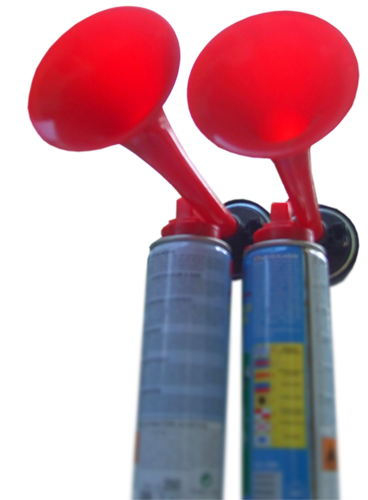
Later, I made experimental scripted interface for this in Kontakt, based on a kind of button matrix, which can be used, to quickly create sound combinations and play them in round robin.
Here's a sound example, generated by single instance of Kontakt instrument, changing sound clusters with mod wheel while playing...
And here's how interacting with the Kontakt device looks like...
Well, this can sound quite horrible and it sometimes gets way of of tune. It is the nature of these toys, pitch is constantly drifting along with changing air pressure and temperature. These cans can get quite cold after longer periods of decompressing. So, this instrument has a lot of character.
Getting to the point, I've got a crooked deal on this little devil. First off, the pack of samples, 35 samples, plain wav, normalized, 44.1 kHz, 16 bit, mono - this is free to get right here. It weights 6 MB zipped, use them as you please, or as you displease. Now the other twist, Kontakt instrument based on these samples, is available at Sampleism. It comes with raw unprocessed samples, 96 kHz, 24 bit, Kontakt patch and a confusing manual in funny English. It requires full version of Kontakt 4.24 or newer to make it work. Take your pick.
Tuesday, March 25, 2014
Junk percussion.
Junk percussion sample set is side product of Psychodrumma II development. At one point I needed more percussion sounds, I quickly collected some junk around the house and I took a long evening session of banging on stuff. Some of these sounds were incorporated into Psychodrumma soundbanks, but still there were plenty of leftovers. I finally had time to edit them, so today I'm offering household junk percussion set. With a little of reverb on, it sound like this:
List of object used for this sample set: broken 8 mm camera, empty beer cans, bicycle horn, bowed metal plate, broken heater, carton boxes, the remains of an old clothes airer, dirty lid, duct tape, dusty box, hollow plate, iron plate, metal tube, moldy books, motor oil can, oily plate, self propelled plastic toy mouse, plastic bowl, plastic rainpipe, fat chunk of rubber band, rusty lid, rusty saw, shiny lid, shiny pot, some other pot, yet another pot, stapler and woodblocks.
There are 200 wav files, 44 kHz, 16 bit, trimmed and maximized, royalty free to use in your music. Recording equipment: AT3035 microphone, Focusrite ISA One preamp, Echo Audio Audiofire card.
Download here. 13MB zip file, fresh, free and fragrant. Have fun.
For more junk percussion see here.
List of object used for this sample set: broken 8 mm camera, empty beer cans, bicycle horn, bowed metal plate, broken heater, carton boxes, the remains of an old clothes airer, dirty lid, duct tape, dusty box, hollow plate, iron plate, metal tube, moldy books, motor oil can, oily plate, self propelled plastic toy mouse, plastic bowl, plastic rainpipe, fat chunk of rubber band, rusty lid, rusty saw, shiny lid, shiny pot, some other pot, yet another pot, stapler and woodblocks.
There are 200 wav files, 44 kHz, 16 bit, trimmed and maximized, royalty free to use in your music. Recording equipment: AT3035 microphone, Focusrite ISA One preamp, Echo Audio Audiofire card.
Download here. 13MB zip file, fresh, free and fragrant. Have fun.
For more junk percussion see here.
Monday, January 27, 2014
Drum by mouth.
Download - 8MB. The archive contains 222 samples, wav format, mono 44.1 kHz / 24 bit. It's free to get and use in your music. I included Battery 2 kit I assembled for demo track, made from selection of 40+ samples. I suggest you to make your own mapping for your sampler, one included is just a hint.
Saturday, November 30, 2013
The wineglass drone.

And another one, solo too, which was the first improvised take on the drone, (there is a little noise when downtuned, which can be heard here):
And here's an example of butchery on Beehtoven's work, which proves the wineglass as fine tool for murdering a classic:
The Wineglass Drone is available at Loot Audio.
The instrument itself is 130MB in 12 wav files, mappings for sfz and Kontakt. You will need full version of Native Instruments Kontakt 4 or newer to open Kontakt mapping. Sfz version is missing GUI and some controllers, it can be opened by various samplers. Loop points are in the files, so it should be easy to load it to any sampler.
Saturday, October 12, 2013
Breaking bread (crunchy percussion)

You know, it may be a perfect candidate for your bread and butter drum kit. Get it here: download package - 3MB, 90 samples, wav format, mono 44.1 kHz / 24 bit, and for free. Also there's an example kit, using some of the sounds, in Battery 2 and sfz formats. The samples are split into two folders. '44 raw' contains 74 slices cut out of the original 88.2 kHz recording, re-sampled to 44.1 kHz. In '44 processed' folder, you will find heavily processed samples, basically the samples have been slowed down a great deal, cut and then up-sampled to 44.1 kHz. This way I transformed, crunchy bun breaks, into something more or less suitable to mimic bass drum or snare.
Trivia:
1. Matzoh wasn't kosher.
2. The side product of this production has been given to a friendly family of field mice, who live in my garden.
Sunday, September 29, 2013
The Wrench, part 2: Bare hammer
Continuing the story from previous post, I created the second sample set of the wrench. Previously, I've been hitting the middle of the flat side of it, using a hammer with a dampening pad. Now the wrench has been treated with a bare hammer hitting the lower sharp side, which sounds quite different. This set is cleaner and sharper and it does not feature little noisy critters. Also it's heavier, as it has more samples for round robin. Here's a quick improvisation, fiddling with Kontakt's factory effects - auto panning, vowel filter and reverb:
The download - 42MB, includes 9 samples in wav format, mono 96 kHz / 24 bit. There are mappings for sfz and Kontakt 2. This time, I also made a patch for Kontakt 4.24 on which I put a simple, custom GUI, to make myself more comfortable while playing with Kontakt's build in effects. It's the one I used while making the demo. This patch is build of Kontakt's factory graphics and presets, so I don't know, if it will work in newer versions. Again, the download is free, have fun.
The download - 42MB, includes 9 samples in wav format, mono 96 kHz / 24 bit. There are mappings for sfz and Kontakt 2. This time, I also made a patch for Kontakt 4.24 on which I put a simple, custom GUI, to make myself more comfortable while playing with Kontakt's build in effects. It's the one I used while making the demo. This patch is build of Kontakt's factory graphics and presets, so I don't know, if it will work in newer versions. Again, the download is free, have fun.
Thursday, September 19, 2013
The Wrench.

Download package - 25 MB, 5 samples in wav format, mono 96 kHz / 24 bit. There is a mapping for Kontakt 2 (or newer) and a draft version for SFZ. In Kontakt version you can use mod wheel to control release time. Also there is bonus Kontakt program with a pad sound, where the samples are layered in stereo. Both programs are dry, so you may want to pick your own reverb. This wrench is free to download and use.
Saturday, September 14, 2013
Scratch the balloon.
This is something I found on my hard drive. From a recording that I made seven years ago, a set of scratchy noises, that I produced by tearing a rubber party balloon with a wet finger. Yesterday I mapped them in Kontakt to use as an "instrument". It sounds like this:
Download package - 3 MB, 32 samples in wav format, mono 44,1 kHz / 24 bit and a mapping for Kontakt 2 or newer. The scratches are simply assigned to keys, from F2 to C5 and mod wheel controls the sample start position. I find it most fun to play scratch sequences while fiddling with pitch and mod wheels. As a bonus there are 4 "hit" samples, which are sounds from the same session, made, as you may guess, by hitting the thing, instead of tearing it. These are mapped to C1-E2 range in some awkward way. Free to download and use.
Download package - 3 MB, 32 samples in wav format, mono 44,1 kHz / 24 bit and a mapping for Kontakt 2 or newer. The scratches are simply assigned to keys, from F2 to C5 and mod wheel controls the sample start position. I find it most fun to play scratch sequences while fiddling with pitch and mod wheels. As a bonus there are 4 "hit" samples, which are sounds from the same session, made, as you may guess, by hitting the thing, instead of tearing it. These are mapped to C1-E2 range in some awkward way. Free to download and use.
Sunday, August 18, 2013
Stone age percussion kit.

Sound demo - this is made of raw samples, with no effects:
And here's a song, in which I used this fine percussion kit for all of the "drum" sounds:
Download package - 9MB, includes samples in wav format, stereo 96kHz / 24 bit and mappings for Battery 2 or newer, which should also load into Kontakt. Not all of the sounds are mapped in the Battery kit, so take it as a demo and explore the sounds. Also there are no velocity layers or fancy programing, it's stone age kit after all. Free download.
Balloon picking session.
I found audio file I recorded some time ago, with sounds made of a rubber balloon. The technique was picking, similar to picking strings, just picking the balloon surface, the sounds were somewhat percussive and somewhat tonal. Pitch could be modified by squeezing it and was rather unpredictable. It has been chopped up and made a Kontakt instrument.
Sound demo:
Download package - 10MB, includes samples in wav format, 96kHz / 24 bit and mappings for Kontakt 2.2.4 or newer. Free download.
And here's the discussion at KVRaudio.
Sound demo:
Download package - 10MB, includes samples in wav format, 96kHz / 24 bit and mappings for Kontakt 2.2.4 or newer. Free download.
And here's the discussion at KVRaudio.
Zombietronic drums.
I always loved weird robotic drum machines. This is set of electronic drum hits that I generated using virtual synthesizers and effects, back in 2008. It's in the face, electric slapping, whit no fancy velocity layers and such.
Sound demo:
Download package - 4,5MB, includes samples in wav format, 44,1 kHz / 24 bit and mappings for Battery 2 (which can be also loaded to Kontakt 2 or newer, or possibly, some other samplers). Free download.
And here's the discussion at KVRaudio.
Sound demo:
Download package - 4,5MB, includes samples in wav format, 44,1 kHz / 24 bit and mappings for Battery 2 (which can be also loaded to Kontakt 2 or newer, or possibly, some other samplers). Free download.
And here's the discussion at KVRaudio.
Wednesday, July 17, 2013
Technics M33G feedback loop tone generator

Sound demo:
The files are 96kHz/24 bit, range it E4-B0, plus the lowest sound I could get. Above E4 the deck would go rocket high frequency, so it was rather impossible to match higher notes. Lowest tones are hardly tonal, but I recorded them anyway. More info in readme.txt
Download package - 10MB, includes samples in wav format, mappings for sfz and Kontakt 2.2.4 or newer. Free download.
And here's the discussion at KVRaudio.
Subscribe to:
Posts (Atom)