Beat Knitter is a tiny drum machine and random drum pattern generator for Kontakt. It features a one-click-pattern generator, I've been experimenting with, it attempts to create a consistent random four track beat of bass drum, snare and open/closed hat. After some strangely complicated machines, this one has a simple approach: press the button, get a random beat.
The instrument has a very simple sound set, consisting of few one shot sounds. It has a basic four track sequencer, you can control overall velocity and a speed rate of each track. Besides one-button pattern generator, there are several other automated functions, some different, more or less random pattern generators and several pattern transformations, tracks can be shuffled, mirrored, de-synchronized, inverted and even there's 4x4 field 45 degree rotation, so you can play the pattern upward-down...
Drum pattern can be exported to MIDI clip anytime, via drag'n'drop, so the machine can be used to quickly sketch different variations of a beat to use with another instrument.
Here's how it works:
The machine is free to get and make noise with. Download here. You will need full version of NI Kontakt 5.6.6 to run it. Leave me a note if you find it fun, or useful, or garbage.
And now something completely different... A step sequencer.
Well, it really is a bit different. Rhythm Assembler is a drum computer script I wrote for Kontakt, remains of a cancelled project. Usually a step sequencer has a regular grid, you can use to place notes. Here, you define the grid structure, assuming there's a note at every step. It may seem backwards, but once you overcome old habits, it may be simpler to do it this way. Example, you want a four on the floor, you only need to program one step. Also, I feel, breaking down a rhythm to such formula, gives me a better understanding, of how the rhythm works.
The machine offers 8 sequence tracks, each can have a different grid sequence with different cycle loop. Grid step is defined as a multiplication or fraction of base duration, like "1 quarter note", "3 sixteenth notes", "1/3 half note" or "3/4 whole note". On top of that you can program a repeat sequence, telling the machine how many times to repeat a grid step. Considering both sequences can have a different loop cycle, it is possible to program fairly complex rhythms with a simple formula. Also the sequencer is not bound to a time signature, you can program odd, irregular rhythms, rhythms with asymmetric measures.
Another, somewhat uncommon feature of the sequencer is the "humanizer" function, which not only can delay notes by random duration, but can play them too early as well. This "timing error" function can be configured separately for each track.
And here's a quick overview video:
Rhythm Assembler is just a script, it comes with no samples and no instrument patches. There are script preset files, you can add to an existing instrument. Which is also the reason, there is no custom graphic interface and the background is black (for the workaround to disable instrument's background image). The script requires Kontakt 5.6.5 or later to work. It could be rather easily ported to any earlier version of Kontakt 5 and with some work and (loosing option to rename sounds) to Kontakt 4.
The script is free to download and use (although it's not free to re-distribute). DOWNLOAD IT HERE. To install the script, you need to locate Kontakt's user preset/scripts folder and copy the "Rhythm Assembler" directory there. There are several example presets, with pre-programmed rhythms and an "empty" preset.
There's some further beta development, you can follow here (scroll down the thread).
Beat Assembler XT is drum computer instrument based on experimental design, extended version of previously posted Beat Assembler 48. It is using randomly or manually generated pattern model, which is then being used as basis for creating a drum sequence. The machine is using series of quantizers and sound mappers to re-shape model pattern, fitting it into a time-frame of choice, allowing user to observe the results on the fly.
New and expanded features in XT version:
bigger master sequence size (128 notes) and more optimized calculations, which it would require,
99999 automatic pattern generator presets,
up to 16 voice groups,
drag'n'drop MIDI export, drop final pattern directly to DAW, or to a file manager to create a midi file,
preset system, 10 memory slots and support for saving sequences to a file (so they can be loaded into another Beat Assembler patch),
displacer mechanism, introduce 'little changes' to a pattern with single knob,
expanded manual editor with handful of new tweaks (including copy/paste mechanism, so you can drop a portion of one pattern into another easily),
filter bank access, filter type can be set quickly from drop-down menu, for each voice group individually,
resizeable drum kit, makes it easy to create custom drum kits, use the machine as sample shell,
12 patches, including a re-creation of obscure polish analog drum machine from the 80's (which I took apart and soldered voice on/off switches, so I could capture each sound separately and then hand programmed re-constructed rhythm patterns in Beat Assembler),
36 hand programmed patterns (as opposed to automatically generated ones) to experiment with (can be loaded from file in nka format),
five background variations, change the machine looks in setup panel,
and, as usual, a fairly confusing manual in strange English.
Here's a video overview, jamming with three instances of Beat Assembler in standalone Kontakt:
It requires full version of Kontakt 5.5.1 or newer to run (Free version will run on Kontakt 4, but XT is actually using Kontakt's new features, like changing filter type from script).
This experiment took me a while to complete and it made me scratch my head pretty hard a couple of times. I wanted a drum machine in Kontakt, that wouldn't be bound to 4/4 signature and standard time grid. Also I wanted to break with table based patterns and have visual presentation more like in a DAW.
Beat Assembler does that and more. It's a drum machine with sequencer, which can generate automatic program according to preset scheme and set of parameters. It creates a master pattern which then is being fit into a time-frame, matching current tempo and time signature. The pattern can be quantized to defined grid, which can use a range of unusual note fractions, like 1/5 or 6/11, everything being visualized on the fly. The machine also lets you define time signature manually, so you're not limited to 4/4 in standalone mode, furthermore allowing some irrational settings like 4/3 or 5/7. So, if you like to experiment with strange percussion patterns, you may enjoy this one.
Additional features include:
four voice groups with automated distribution, where you can set effects and modulation parameters for each group;
manual sequence editor, so you can move notes around the grid;
note recorder, so you can play a pattern by keyboard and then quantize it inside out.
Here's a video, where I'm trying out the machine:
Beat Assembler is free to get and play with. It requires full version of Native Instruments Kontakt 4 or newer. Download it HERE. 6 MB, RAR archive. Have fun!
If you like the idea, I have made paid, expanded version of the machine, named Beat Assembler XT, you can read about it here.
Concerning the midi export as requested in the comment, Kontakt 4 can't write midi files. But it does output midi! All you need to do is to go to 'options > engine > send midi to outside world' and make sure 'script generated notes' option is selected. Now, if your DAW supports it, you can patch Kontakt's midi output to a midi track and start recording right away. Beat Assembler XT does export midi clips via drag'n'drop mechanism in Kontakt 5.
Bedroom Producers Blog released super-fun Game Boy drum kit today. I had the pleasure to make Kontakt gadget drum machine based on this kit, it is named Game Bot. The device is using Cracklebot / Haunted Jukebox code, with some new twists and improvements. It is running 10 sets of step sequencers to animate notes and effect settings, sequencer program is generated automatically on user's request. Unlike previous machines Game Bot accepts incoming notes to simply play the drum kit, in which case program and controls can be used to create different kit setups and/or to animate effects using modulation sequencers.
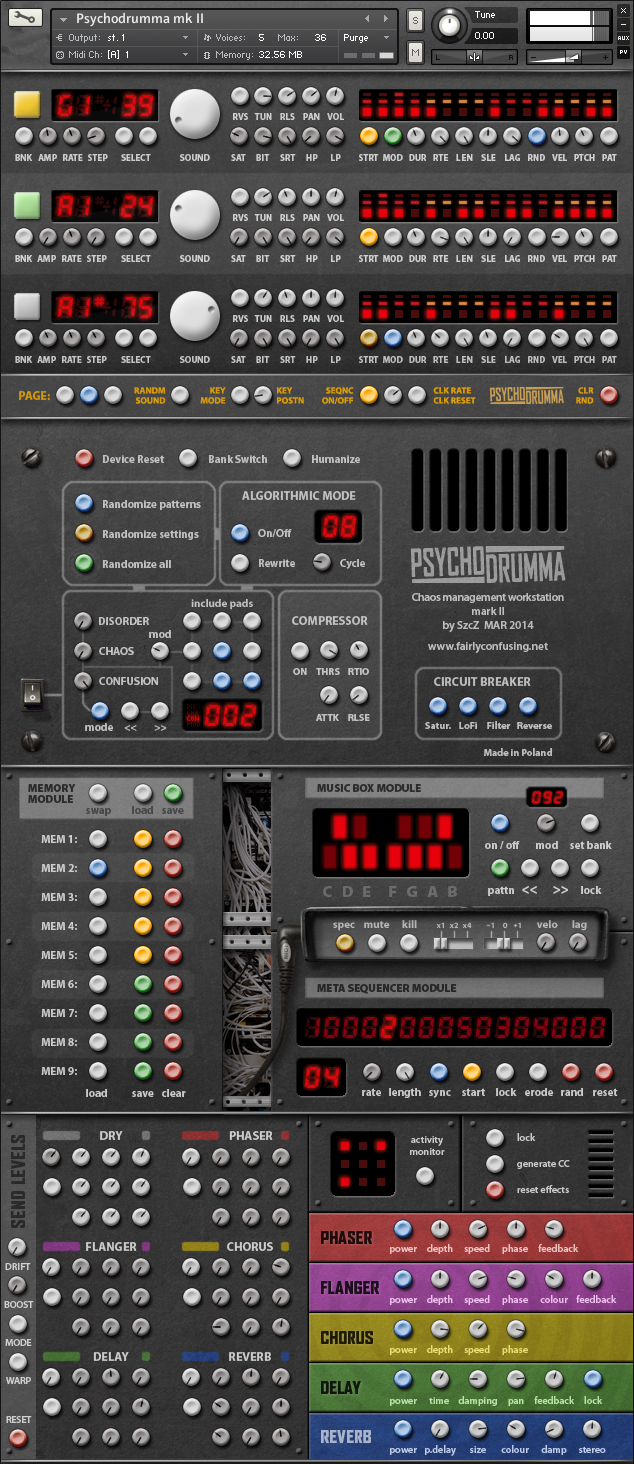
Psychodrumma mark II is reworked and expanded version of Psychodrumma, fantasy, neo-retro drum machine/music generator for Kontakt 4 sampler. It can act as a drum machine and generate random rhythmic, ambient or melody patterns. It is based on matrix of nine synchronized step sequencers, and a meta-sequecer. Most of settings can be programmed automatically by randomizers, creating strange machine music. It has plenty of knobs and a lot of flashing lights. The device comes with three banks of 100 one shot samples each, these eclectic sets were made from synthesized sounds (digital and analog), field recordings, animal sounds, unusual percussion, bass and guitar tones and noises, voice fragments, objects (metal plates, pots, radiators, machine parts, bicycle horn, plastic tubes, firecrackers), radio noise, vinyl crackles, car engine and icy snow squeaking under heavy boots.
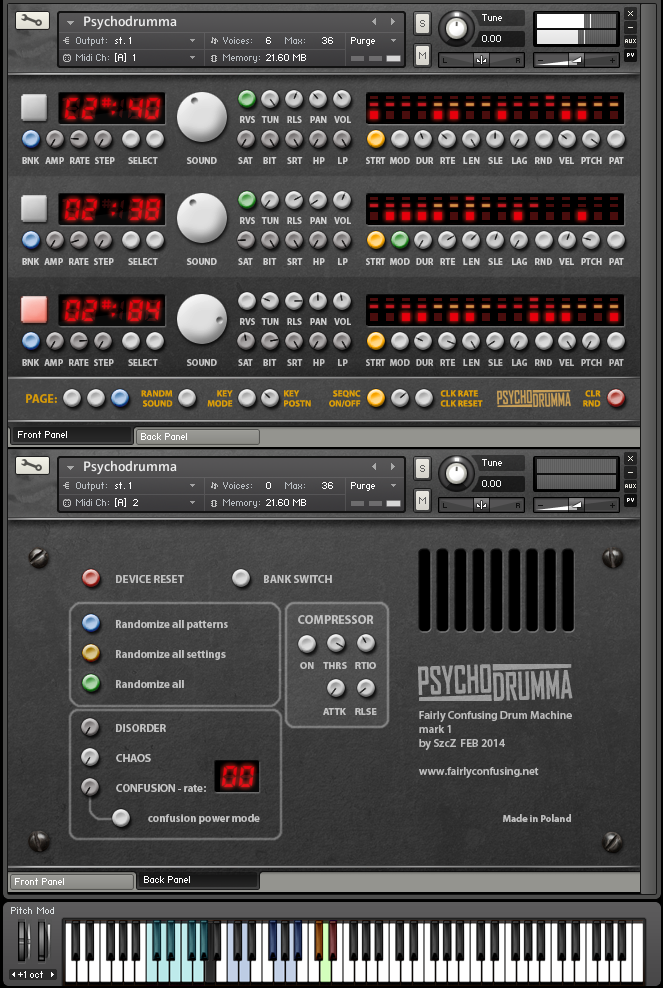
You can get mark I version for free two posts below.
Some of new features of mark II version:
algorithmic mode, makes it possible to playback or loop sequences of random events,
music box, tunes melodic samples to defined pattern, to create melody sequences,
reworked and expanded sound banks, including third tonal bank to use for generating melodies,
saving and loading presets, presets can then be sequenced in meta-sequencer, to create tracks inside the machine, preset-set can be then saved to file,
automated effects rack.
And are example tracks, sequenced entirely in machine's meta-sequencer:
Rhythm patterns were partly programmed by hand and party shuffled by the machine. Melody lines were applied entirely by machine's looped randomizers.
Note, you need full version of Native Instruments Kontakt 4 or newer to make it work. It won't work properly in Kontakt Player. Also, as it's written in KSP script, it is quite impossible to import it to any other sampler.
Psychodrumma is nonsensical drum machine for NI Kontakt 4, focused on creating random and randomly evolving rhythmic patterns. It is experimental sound device and although it could be used as a regular drum machine, it would be probably impractical. It is build of nine modules, called pads, each can playback a sound from one of two banks of 100 samples each, each has separate sound control rack and its own simple sequencer. All sequencers are synchronized with host tempo, but can run at different relative speeds and their start points can be de-synchronized, so to say. The fun feature of Psychodrumma is, that it can play by itself, all of pad's settings can be randomized on user input, gradually or periodically. You can just tune settings, let it play and observe evolving waves of randomness.
This device comes with its own sample set. It is eclectic selection from variety of sounds I have recorded over the years: synthesized sounds, field recordings, animal sounds, unusual percussion, bass and guitar noises, voice fragments, household objects, radio noise, vinyl crackles, car engine, fireworks, icy snow squeaking under heavy boots or all the above mixed an layered in one sample. However, it can be used with any set of samples, you would just need to rename them and replace 'factory' files. Files are named by numbers, so it will be fairly easy, if you are familiar with any batch renaming software.
There's no point in getting further into details here.
If you like, see the PDF manual.
Now, some sound examples. First a set of nine randomly generated patterns, they change every 4 bars across 100BPM 4/4 track, at the end the track tempo is automated to slow down.
Second example is made with the same template, but 'factory' banks has been replaced by randomly selected group of acoustic drums samples, mainly from Kontakt's library, orchestral and world percussion. Note that these sounds are obviously not a part of the download, this is just an example of how the device can sound with alternative sample set.
Finally, here's a video, showing how operating it looks like. First, I construct a simple rhythm, using factory preset sequence patterns and then wash it out with randomizer functions.
Psychodrumma is free to download and use in your music. You will need full version of Kontakt 4 or newer to make it work. The download is 19MB, it contains 200 wav files, 24/44, manual in PDF and sampler program. Get it here. Have fun.
Psychodrumma is followed by Psychodrumma mark II, read about it here.