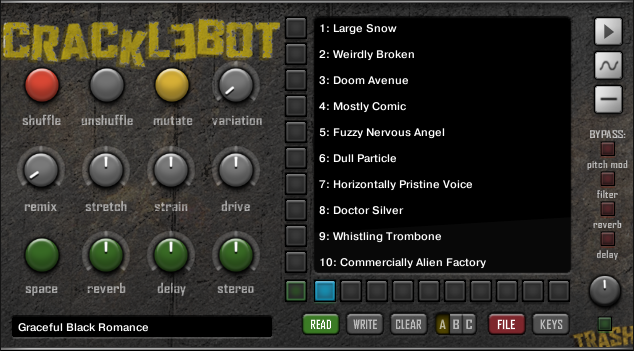
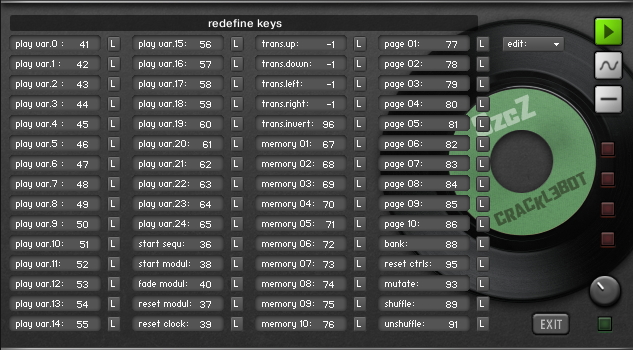
I bundled special version of Cracklebot noise machine with Haunted Jukebox. I nicknamed it "Cracklebot unchained", the only difference from regular versions is, that "unchained" bots do include setup and configuration panels, so one can experiment with different generator engine settings.
I posted two "guided tour" videos, where I play with Cracklebot configuration. I used Youtube annotation system to comment on what is actually happening. See, if it looks like fun or not.
I had a couple of new ideas while playing with Cracklebot noise machine that I posted yesterday. They spawned a modified version of the instrument, which I labeled Cracklebot Red. To find what a cracklebot is, please read previous post.
Changes in red edition:
used 4 convolution units instead of 2, replaced the delays, this needs considerably powerful CPU,
reverb mixdown knob now controls return of all 4 units, delay mix knob is replaced with dry signal level knob, so now you can listen to just wet output of all reverbs, which is what I was aiming for,
there are now 12 layers/tracks per groove instead of 9,
there are small adjustments in groove generation constraints, larger possible sequences, different possible sequence speeds, etc.
The archive doesn't include the manual, so if you really want to read it, get the regular bot.
Further late night experiments, took me to yet another incarnation of the machine. I wanted to see, how would it sound like, when pushed to 8 convolution reverbs and 16 layers, with more relaxed groove generation setup and different, evolving modulator signal distribution. If you're into evolving weird ambiances and have lots of CPU cycles to spare, you may see, if you can get it working.
Cracklebot is automated drum machine based on vinyl noise samples. I sampled worn and dirty, empty grooves from my vinyl collection. Lead-ins, lead-outs, silent parts in between tracks, those have been chopped to 115 short slices or pops, crackles, scratches and noises. Cracklebot is sequencing them into tempo synchronized, noise grooves. The machine can create new, random patterns on a single click, so it's quite fun play with.
It looks and sounds like this:
This virtual machine requires full version of Native Instruments Kontakt 4.2 or newer. It's (Cracklebot, not Kontakt) free to download and use in your music. Right here - 4MB. Includes short confusing manual in funny English. Have fun.
Also check further mutations of the machine: Unchained - with configurable sequence generators. Red and Violet - for ambiance cracklescapes.
"A Touch of Junk" is a little set of unusual, found-sound percussion samples captured with contact microphones. It has similar vibe to Junk Percussion set, but the "touch" set is captured straight from the surface. Here's the list of objects being hit, scratched, shaken or bowed: an old baking pan, large pot lid, roast rack, a short glass, a tall glass, wooden bar, a wrench, plastic ruler, plastic bottle with carbonated water. The last object was particularly fun to play with as the sound would depend on inside pressure or the angle the bottle was held.
Here's a sound example. And another one. These rhythm patterns have been created with Haunted Jukebox, Kontakt based, auto-drumming machine. The machine is auto-applying some effects, but it will give you the idea.
There are 145 samples in WAV format, 16 bit, 44,1 kHz. They are free to get and use in any kind of music you see fit. Have fun. Download here - 13MB.
Haunted Jukebox is experimental automaton for generating abstract noise grooves, that I have built in Kontakt sampler. It is not quite a musical instrument, it doesn't take notes as input, rather it works as a jukebox, it takes a number and plays a groove. It generates pure machine music, calculating a sort of composition derived from input token. User can select the token using set of 25 buttons, each button representing single bit in token number. Then the machine creates a program for 8 track step sequencer and modulation programs for each layer, using step sequenced modulators that I used before in Quescape or Bleepman. Each of 8 tracks / layers has 12 independent modulation sequencers running at different speeds and different program length. So generated groove can get quite sophisticated. To make it more funny the machine also generates a name for each groove. It is possible to mix different tokens across layers, which can be done manually or automated with 'evolution' function which will gradually change grooves. All grooves are synchronized with host tempo. Here's a video of the machine in action:
The machine requires full version of Kontakt 4.2 or possibly newer and considerable amount of CPU, also it relies on transport synchronization with host. It might happen, it won't initialize properly in certain hosts, at least until you start playback. In short, it may or may not work for you, you will need to find it out experimentally.
There are two free sets/configurations available:
Minimal Noise Set is made, as the name suggests, of different noise fragments. This is 10MB download and is free to get and use to make noise, privately or commercially.
Junk Percussion Set is using junk percussion samples that I recorded some time ago. It's also free to get. The download doesn't include the samples, which you need to get by separate download here. Unpack samples to 'samples' directory.
If you like the idea and the machine works for you, there is third set available at Sampleism. This version, besides different sample set, offers access to configuration panels (fine-tune engine, midi learn for keyboard automation, groove generator setup).
This is follow up for Alimchord, imaginary musical instrument for Kontakt. It is built on samples from 7 tone kalimba and a wooden stick captured using various configurations of contact microphones. Paranoid edition has more controls, more samples and a preset memory function.
There is 290MB load of 96/24 wav samples, in three velocity layers and up to nine algorithmic round robins. It sounds somewhat different from regular model, percussive sound partials and release noises are the same, but tone partials is significantly more detailed. It is available at Loot Audio. Note that you need full version of Kontakt 4.2 or newer to make it work. Also, this instrument can consume a lot of CPU, there are multiple sample layers and three convolution reverbs in use, if you have doubts, try regular edition first.
Alimchord is rare electroacoustic keyboard instrument. Few units have been produced in Poland in late 60s, however most of them broke down rather quickly. Today, I'm happy to bring it out of obscurity with a Kontakt based emulation. It does mimic most of 262144 valve switches combinations, although some of them appear to be broken. Here's screenshot and sound example.
Operating the instrument is quite simple, the set of switches will change the sound, in more or less apparent way each combination has a unique vibe. Two additional switches can be used to reset pattern or shuffle switches in random way. Ambiance knob will set the amount of ambiance effect, Stereo adjusts microphone placement and panorama and Tension will influence keys sensitivity, like a velocity curve.
This fine instrument is available free of charge, get it here, 15MB compressed archive. You need full version of Kontakt 4.2 or newer to make it work. Note that due to its triple convolution design, it is not recommended to those faint of CPU. Have fun.
If you like to have more control and more detailed sound, try paranoid edition.